
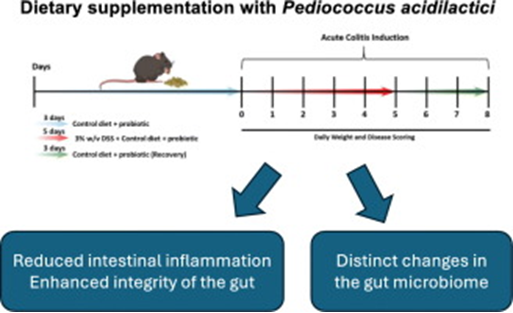
A significant research study demonstrating the anti-inflammatory and protective effects of a novel, wild-type probiotic strain (Pediococcus acidilactici SK2) was recently published in the international scientific journal NFS Journal (https://doi.org/10.1016/j.nfs.2026.100283).
The study evaluates the potential of this strain, which was isolated from the human gastrointestinal tract, using a mouse model of dextran sulfate sodium (DSS)-induced ulcerative colitis.
According to the study’s findings:
– Suppression of the inflammatory response: Administration of Pediococcus acidilactici SK2 partially mitigated body weight loss and alleviated the clinical severity of the disease. Furthermore, a significant reduction was observed in the mRNA and protein levels of pro-inflammatory cytokines (such as Il-1β and Il-6) and chemokines (Cxcl2, Ccl3) in colonic tissue.
– Enhancement of the intestinal epithelial barrier: Probiotic treatment increased the expression of genes associated with mucin production and tight junction proteins, including Muc2, Tjp1 (ZO-1), and Ocln (occludin), thereby contributing significantly to the preservation of intestinal epithelial integrity.
– Modulation of microbial composition: 16S rRNA sequencing analysis revealed that, although the strain did not fully restore overall alpha diversity following DSS-induced dysbiosis, it promoted a distinct, functionally protective restructuring of the gut microbiome. Specifically, it increased the relative abundance of beneficial bacterial genera, including Bifidobacterium, Dubosiella, Ileibacterium, and Allobaculum.
These findings demonstrate that the beneficial effects of P. acidilactici SK2 are not primarily driven by the complete restoration of the gut microbiome but rather by targeted immune–epithelial mechanisms and the reduction of inflammatory burden.
The strain emerges as a highly promising probiotic candidate for the management of inflammatory bowel diseases, highlighting the need for further preclinical and clinical evaluation.
The study is the result of extensive collaboration among academic and research institutions, including the Democritus University of Thrace, the School of Medicine of the University of Crete, the Institute of Applied Biosciences (INAB) of the Centre for Research and Technology Hellas (CERTH), the University of the Aegean, and QLC.
The research was conducted within the framework of the initiative “Flagship Action for Sustainable Agri-Food Systems – Applied Research, Infrastructure Development, and Services for the Sustainability of the Sector.”